Assess a care pathway with our calculator
A step-by-step guide
A care pathway assessment looks at the whole patient journey to show where environmental impact can be reduced without compromising patient safety or experience.
Our method uses life cycle assessment (LCA) and can range from a high-level estimate to a full study using primary data, depending on your goals and data.
This guide walks you through a high-level assessment using our free patient care pathway carbon calculator. It’s simple, repeatable and designed for beginners. Results are indicative, and the calculator covers carbon only, while the full method also includes water and waste. For more detailed assessments, tools such as CARESA also apply our method.

Before you start
You’ll need:
- The patient group and condition you’re assessing (e.g. adults referred for elective cholecystectomy via the outpatient route)
- A description of a typical patient’s journey on that pathway
- Patient numbers, or a representative sample
It helps to have:
- Activity data, such as outpatient appointments per patient
- How patients travel to appointments, and roughly how far
- A colleague who knows the pathway well, if it isn’t yours
Start with what you know and refine later. A rough assessment is far more useful than none.
The building blocks: pathway modules
You’ll group activities into modules: types of clinical contact or activity, such as a GP appointment or surgical procedure. Each module has a pre-calculated carbon emission factor, so you don’t need to work out individual activities from scratch.
The current modules are:
- GP consultation: a standard primary care appointment
- Emergency department visit: an A&E attendance
- Surgical procedure: an elective or emergency operation
- Inpatient bed day: one day as an admitted patient
- Self-management: activities the patient carries out at home
- Patient travel: journeys to receive care
Each module has its own guidance document explaining what’s included and how to apply it.
The six steps
We have broken the process down into six simple steps. The first three focus on mapping the pathway. The last three focus on measuring and interpreting the environmental impact.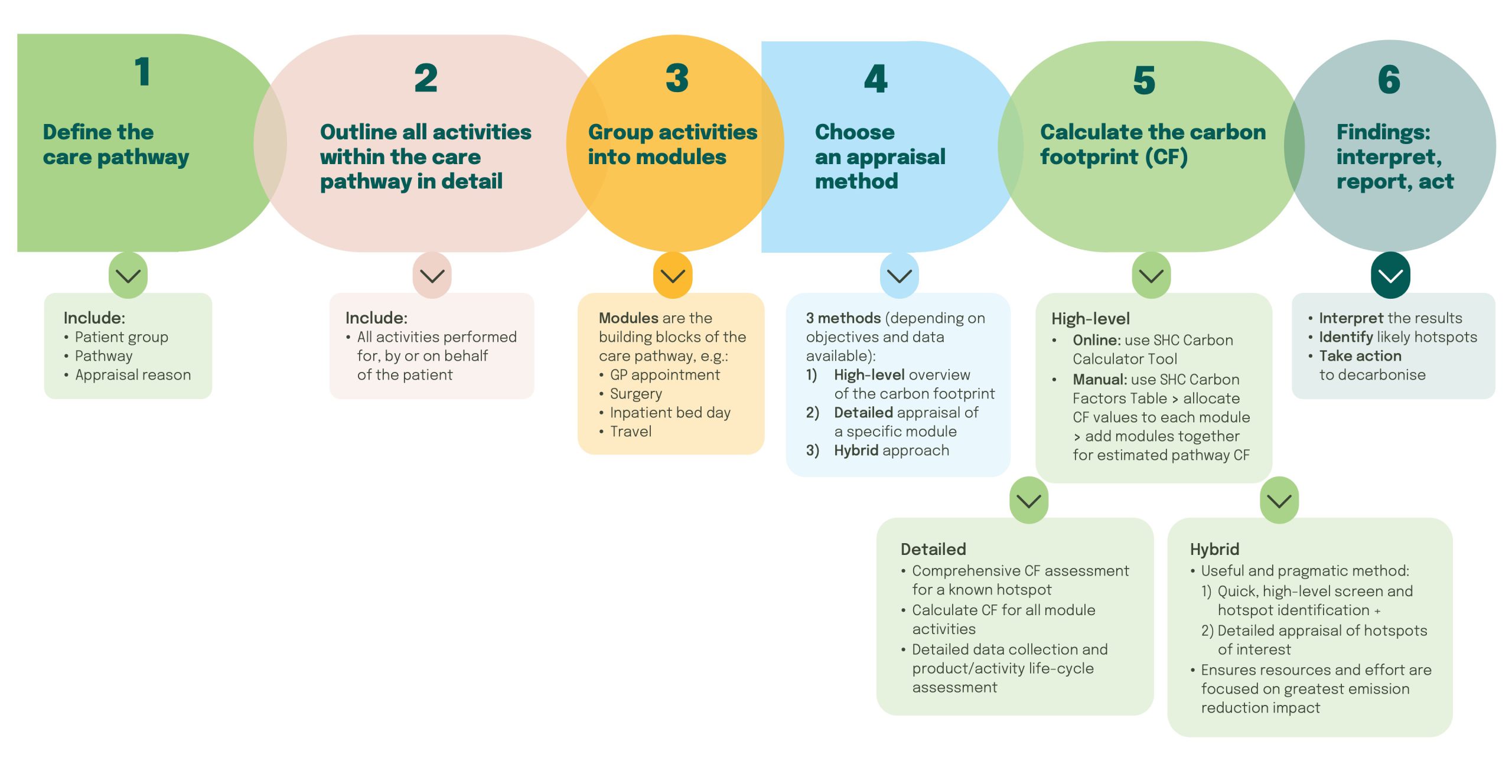
Step 1: Define the care pathway
Be specific about what you’re assessing:
- Who is the patient, and what condition do they have?
- Where does the pathway start and end?
- Why are you doing the assessment? For example, to identify carbon hotspots, compare two models of care or support a business case for change.
The clearer your definition, the more useful your results.
Example: “We will assess the adult elective laparoscopic cholecystectomy pathway via the outpatient referral route, using 10 patients as a representative sample, to identify carbon hotspots and target them for quality improvement.”
Step 2: List every activity in the pathway
Write down everything that happens to a typical patient, from start to finish: every appointment, test, procedure, admission and journey. A simple list is enough. You don’t need a formal process map.
Example: For the cholecystectomy pathway, activities included:
- GP appointment for suspected biliary colic (including patient travel)
- Diagnostic tests: ultrasound scan and blood tests
- Follow-up GP appointment
- Specialist surgical outpatient clinic
- Pre-operative assessment clinic
- Day-case laparoscopic cholecystectomy
- Follow-up specialist outpatient clinic
Step 3: Group activities into modules
Sort each activity into one of our modules. If something doesn’t fit neatly, use the closest match and note your assumption.
Example:
- GP Consultation (×2)
- Diagnostic Imaging (×1 ultrasound)
- Outpatient Clinic (×3, using GP consultation as a proxy)
- Surgical Procedure (×1)
- Patient Travel (multiple trips)
Step 4: Choose your approach
Choose based on your purpose and the data you have.
Quick overview. Best for a first look at the pathway, or making the case for a fuller assessment. Apply a pre-set carbon value to each module using our calculator or Emission Factors Table, then add them together. It’s quick, with minimal data needed.
Detailed appraisal. Best for a module you already know is a major contributor. Collect detailed activity and product data and calculate its footprint from first principles. This gives a precise, defensible figure but needs more time and data, so it’s usually done by teams with research or audit capacity, or in partnership with us.
Hybrid. Best for a thorough assessment without excessive data demands. Start with a quick overview to find the hotspots, then do a detailed appraisal of those modules. This is the most practical approach for most teams doing their first assessment.
Step 5: Calculate the environmental impact
Calculate the impact of each module, then add them together for the total pathway footprint. The fastest route is our patient care pathway carbon calculator, which turns your module frequencies into a carbon figure automatically. Or use our Emission Factors Table to calculate it manually.
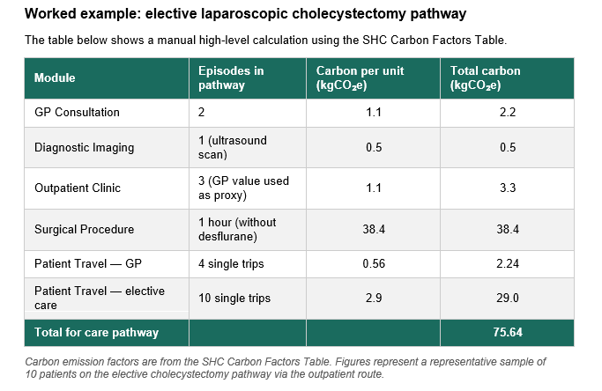
Worked example: the table below shows a manual high-level calculation for the elective laparoscopic cholecystectomy pathway, based on a representative sample of 10 patients.
Step 6: Interpret the results and find your hotspots
Where is the carbon concentrated? In most pathways, a few activities account for most of the footprint. These are your hotspots, where changes will make the biggest difference. The same applies to any water or waste data you’ve collected.
Example: In the cholecystectomy pathway, the surgical procedure (38.4 kgCO2e, more than half the total) and patient travel (29.0 kgCO2e) together accounted for around 90% of the carbon. Possible actions included:
- Streamlining pre-operative appointments to reduce separate trips to hospital
- Green theatre practices, such as low-carbon anaesthesia, reusable equipment and switching off lighting and equipment when not in use
Even a high-level assessment is the starting point for a meaningful conversation about sustainable care.
What happens next?
Once you have your results, you can use them to:
- Make the case for change: present your findings to clinical leads, service managers, or your trust sustainability team
- Design a more sustainable pathway: use the hotspot analysis to target changes where they will have the most impact
- Compare models of care: assess the environmental impact of a new or alternative pathway against the current one
- Contribute to the evidence base: we are building a library of care pathway assessments across different clinical areas
Taking action on your findings, including specific decarbonisation strategies by clinical setting, is covered here.
Need support?
We work directly with clinical teams, NHS organisations, and industry partners to design and deliver care pathway assessments. Whether you need light-touch guidance or hands-on involvement, get in touch.

