
Guidance on how to produce a carbon footprint of maternity services
Maternity Care and Climate Change
Maternity services are one of the NHS’s high-volume services, with over 673,000 births in the UK in 2022. Each of these will have been preceded by approximately 30 weeks of regular antenatal care and followed up with postnatal care.
The NHS is responsible for 4% of the UKs carbon footprint – equivalent to the entire emissions of Croatia. NHS services and resource use is therefore contributing to the environmental and ecological crisis. Pregnant women and infants are some of the most vulnerable to the effects of climate change, such as extreme heat, air pollution, and natural disasters, which can exacerbate health issues, leading to complications such as preterm birth, low birth weight, and respiratory problems.
Further, significant inequalities persist in maternal services across the UK, disproportionately affecting women and birthing people from ethnic minorities and socio-economically disadvantaged backgrounds. Black women are four times more likely to die in pregnancy or childbirth compared to white women, and Asian women face twice the risk. Additionally, women from the most deprived areas are more likely to experience stillbirth compared to those from the least deprived areas.
Climate change and health are inextricably linked. Disadvantaged communities are often more exposed to environmental hazards, are less able to recover from these hazards, and often have reduced access to high-quality healthcare. This compounding effect exacerbates health disparities.
Addressing inequalities and environmental harm from healthcare services not only improves health outcomes and experiences of care but contributes to a more just and sustainable healthcare system.
Green Maternity Project
The project ‘Taking collective action to deliver low carbon, equitable maternity care’ (Green Maternity Care) is a project that aims to make maternity care more sustainable and equitable. The project is a collaboration between the Royal College of Obstetricians and Gynaecologists (RCOG), the Royal College of Midwives (RCM), the Centre for Sustainable Healthcare (CSH), and the Sustainable Healthcare Coalition (SHC). The project launched in April 2024 and is running for one year, funded by SBRI Healthcare.
The project’s goals include:
- Studying maternity care pathways
- Identifying areas of health inequity and carbon hotspots
- Supporting maternity teams in running quality improvement (QI) projects to address these issues through a Green Maternity Challenge
- Bringing the maternity community together to discuss how the findings can influence future care.
- We have developed this guide as a result of our learnings from mapping and carbon footprinting some pilot centres as part of the project.
Carbon footprinting for Maternity Services
This guide outlines a six-step process to appraise the environmental sustainability of maternity care pathways, with examples for reference. This is derived and adapted from the Sustainable Care Pathways Guidance, which gives more detailed advice and covers the steps in more detail.
1. Define the care pathway to be assessed
This should include the specific patient group and parts of the maternity service pathway being appraised and the reason for the appraisal. The Green Maternity Project highlighted the following maternity care pathways for priority attention:
• Antenatal care
• Hypertension care
• Induction
• Intrapartum care pathway : midwife-led, obstetric unit
• Pelvic floor care
• Postnatal care
• Infant feeding
A map of maternity services included in the Green Maternity Project is available here. Each pathway was mapped based on the respective NICE Guidance and with input from stakeholders including midwives, obstetricians and people with lived experience. The map is a MS Powerpoint file; it will open in “slide show” mode and you can navigate around the various pathways by clicking on the dark green boxes.
2. Create a detailed picture of all activities forming the care pathway
In order to fully appraise a patient care pathway, all clinical interactions and activities within the pathway must be mapped. This includes all distinct healthcare-related events performed for, on behalf of, or by a patient.
Example:
Antenatal care pathway
• Patient presentation to GP – patient travel, staff travel, consultation + assessment, service setting utilities & consumables
• GP refers patient to antenatal service – patient & staff travel
• First antenatal service clinic – patient & staff travel, consultation + risk assessment, service setting utilities & consumables
• Programmed antenatal clinics – patient & staff travel, ultrasound scan(s), blood tests, consultation + risk assessment, intrapartum care decision making, service setting utilities & consumables, referral to specialist care, e.g. hypertension, gestational diabetes, pelvic floor health, raised BMI, etc.
• Antenatal classes – patient & staff travel, service setting utilities & consumables
• Specialist antenatal clinics – patient & staff travel, ultrasound scan(s), blood tests, consultation + risk assessment, service setting utilities & consumables
The table below shows the activities that might be associated with the various maternity care pathways.

3. Group activities into modules
To simplify the appraisal process and identification of hotspot areas, linked activities can be grouped together into care pathway modules. These modules form the building blocks which make up the total care pathway.
Example:
Antenatal care pathway
• Staff commuting
• Staff travel
• Patient travel
• Service setting utilities & consumables
• Diagnostic services
• Pharmaceuticals
4. Choose an appraisal method
Once the care pathway modules have been mapped, an appraisal of environmental sustainability can be performed in several different ways, depending on the data available and objective of the appraisal.
We have identified three main methods which each serve different purposes – these range from a high-level overview of the whole pathway to a detailed, granular analysis of an area of interest.
5. Calculate the carbon footprint
High level appraisal:
In this type of appraisal, the user will not be collecting or calculating carbon emission data specific to their pathway. This approach uses existing published data to represent average estimates for generic activity modules. To support this process, we have collated this data to assign to the following patient modules:
⇒ GP consultation
⇒ Emergency Department visit
⇒ Patient travel
⇒ Surgical procedure
⇒ Inpatient admission
⇒ Patient self-management
The carbon footprint associated with each of these modules can be found in the the Carbon Factors Table this can be used for a manual calculation (see below). Alternatively, the module carbon footprints can be calculated online using our Carbon Calculator Tool. The tool is built in MS Excel and allows for all maternity services listed in Section 1 of this guide to be assessed or, if your interest is focused on one pathway, such as antenatal care, the other pathway tabs in the tool can be bypassed.
The carbon factors listed provide broad estimates of the carbon impact of maternity care activities. Using this approach should not be seen to capture all emissions within a care pathway or specific module. To quantify a care pathway in a more detailed way or to produce one that is specific to your pathway and unit, we recommend following a more detailed and setting-specific appraisal approach.
Detailed appraisal for a module of interest:
Performing a detailed appraisal for a specific pathway module requires an in-depth analysis of all corresponding activities, events and products and then subsequent calculation of the associated carbon footprint using published carbon emission factors. To do this you will need to undertake comprehensive data collection for your module of interest. The steps required for this type of appraisal are beyond the scope of this webpage – please read the guidance documents (specifically the Main Document and individual Module Documents) in the Sustainable Care Pathway Guidance.
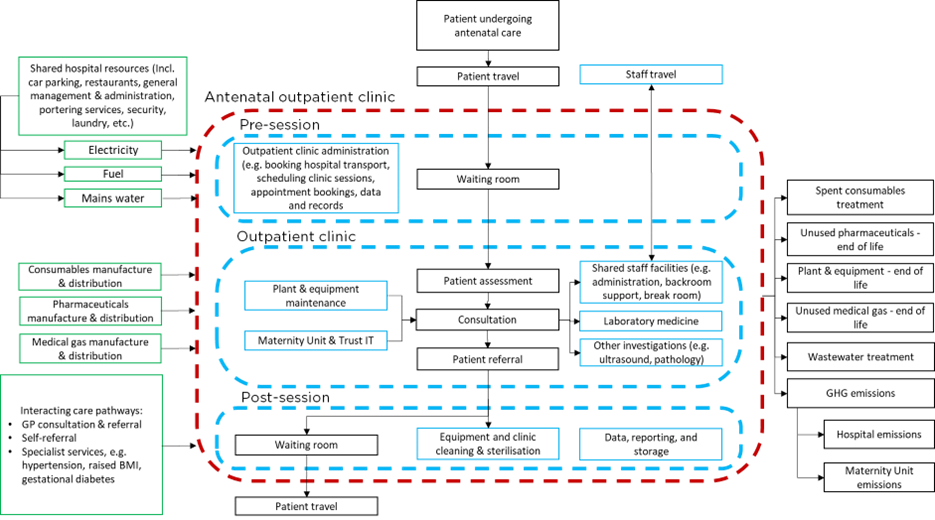
The example below demonstrates the typical range of activities and components required for an outpatient antenatal clinic.
Example:
Hybrid Approach:
A hybrid approach allows the user to tailor the level of detail required, so that in-depth carbon footprinting is reserved for predicted hotspots where the greatest impact can be made. An initial high-level appraisal will act as a materiality assessment for likely hotspot identification.
As the high-level approach utilises generic module-level emission factors and assumptions and provides only an approximation of carbon footprint, the subsequent detailed modular analysis may not match the previously calculated estimates. In this situation, the original pathway assumptions may need to be revisited to ensure that the correct modules are being targeted.
6. Interpret and report the findings – take action
Following calculation of the carbon footprint, you can interpret the results and identify any likely carbon hotspots within the pathway. The largest hotspots contributing to your pathway carbon footprint might usefully where effort can be focused to identify carbon saving initiatives to implement. We have included a selection of resources and case studies for Decarbonising Patient Care Pathways to signpost users where to get started.
For a high-level appraisal the calculated footprint represents an estimate for the patient pathway. The carbon emissions we have allocated to each module have been obtained from a number of sources, each with a different approach to calculating emissions with varying degrees of scope, data quality and collection methods. For this reason we recommend a degree of caution when performing comparisons and advise that this type of appraisal be primarily used to create a baseline for your pathway in order to track the progress of subsequent carbon reductive actions.
This guidance is available to download here.