
About the guidance
The guidance
The principal objective of the guidance documents is to enable more consistent quantification of the sustainability performance of care pathways globally, both those that already exist and new and emerging pathways. It is envisaged that this sustainability information will be used to support decision-makers in their choices related to improving the performance of models of care. Currently, the guidance is limited to appraising greenhouse gas (GHG) emissions, water use and waste generation, but it will be expanded to further environmental and social metrics over time.
The guidance builds upon the requirements of the ISO14040 and ISO14044 Standards for Life Cycle Assessment, the Greenhouse Gas Protocol Product Life Cycle Accounting and Reporting Standard (Product Standard) (1) and the Greenhouse Gas Accounting Sector Guidance for Pharmaceutical Products and Medical Devices (Sector Guidance) (2). It is intended to be used alongside these documents and avoids replication of their content wherever practicable.
The documents are freely available and are intended to be updated as knowledge in this area increases. In particular, it is expected that further care pathway modules and sustainability metrics (social and environmental) will be added over time. The document was developed in 2015 and further information including future updates can be found through the Sustainable Healthcare Coalition website.
The guidance is focused on a limited number of care pathway modules and environmental metrics. It is expected that further modules and metrics will be added over time in order to allow more detailed sustainable care pathway appraisals to be undertaken.
Activity data and environmental metrics calculations are provided for each module. They are intended for use in the appraisal of care pathways. Where a module case study has been used and found to be material to the care pathway being appraised, more specific data shall be collected.
The guidance contains chapters explaining the purpose of the document, common information applicable to appraising the sustainability of care pathways and recommendations for reporting. These are set out in the sections noted below. Accompanying this main document are chapters for individual care pathway modules.
The guidance:
• explains the reasons and benefits of completing a sustainability appraisal of a care pathway and the steps that are necessary in order to do so;
• provides useful definitions, documentation and references to where data required may be sourced from in order to undertake a care pathway appraisal;
• provides specific information on the modules of which a care pathway is comprised, including what shall be included/excluded when undertaking an appraisal, example data, units of analysis and estimates of module performance against environmental metrics; and
• includes examples to show practically how to use the module chapters and to build up a care pathway appraisal.
The guidance includes the following care pathway modules as separate supporting chapters:
GP consultation
Patient travel
Emergency Department visit
Inpatient bed day
Surgical procedure
Self-management
A full care pathway assessment involves the following steps:
■ Define the care pathway
■ Define the unit of analysis (e.g. patient population)
■ Create a detailed map of the activities/modules required
■ Complete a materiality assessment
■ Appraise each module (using example data where appropriate)
■ Add the modules together
■ Interpret and report the findings
The carbon intensity factors built into the guidance and the calculator employ a life cycle approach that includes:
• Manufacture of consumables
• Manufacture of equipment
• Manufacture of medical gases
• Energy use
• Staff commuting
• Waste and water
The data used to calculate the carbon intensity of these activities was collected from NHS England facilities. The data does not include pharmaceuticals as these will be specific to the conditions being managed.
How to use the guidance
The guidance is intended to be used primarily to support the understanding of what are more sustainable care pathways. This may be achieved either by comparing the sustainability of alternative care pathways, or by investigating how to make a care pathway more sustainable, for example through examining hotspots and identifying improvement opportunities This may be either to compare the sustainability of a care pathway or to investigate making an existing care pathway more sustainable.
The modules described in this document are intended to be additive and can be combined logically to construct a care pathway.

Care Pathway Mapping
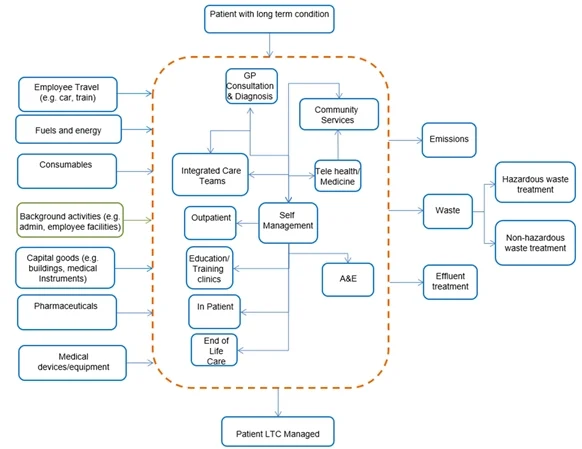
If only a high level appraisal of sustainability is required, the map. An online Care Pathway calculator [https://shcpathways.org/]developed using care pathway data developed through application and development of this guidance is available.
Each module can also be considered as a stand-alone part of the health and care system. Guidance is provided on what the sustainability hotspots are within each module and includes an estimate of the environmental impacts of each service described in the module.
Back – Care pathways assessment
Next – GP consultation